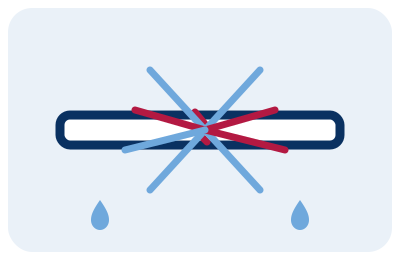
Water spraying or gushing from a pipe, wall, ceiling, or under a sink. Here's what to do about burst pipes in Chicago — including the local factors that change the advice.
Do this right now
Close the nearest valve first
If the burst is at a toilet, sink, or appliance, turn its small stop valve clockwise. This can stop the flow in seconds.
Shut off the main water valve
Can't find a local valve — or the break is in a wall? Close the main shutoff for the whole house now. Don't wait until you 'find' it; close first, label later.
Kill power near the water
If water is near outlets, appliances, or the breaker panel, stay out of standing water and don't touch breakers with wet hands.
Drain pressure safely
After the main is off, open a cold faucet at the lowest point in the house to relieve line pressure — only if it creates no new hazard.
Call for repair
Call (844) 699-1165. Tell us where the break is (wall, ceiling, crawlspace, under sink) and what the pipe looks like (copper, PEX, galvanized) if you can tell.
Burst Pipe in Chicago? Talk to a local pro now.
Free for homeowners · 24/7 · Licensed local pros
What makes burst pipes different in Chicago
- In Chicago, frozen pipes are the #1 winter plumbing emergency — exterior walls, crawlspaces, and vacant properties
- Homes here are often brick bungalows and vintage two-flats, nearly all with basements — which changes where pipes run and how hard they are to reach.
- Clay soil plus freeze-thaw heaving stresses buried lines every winter
- Combined sewers mean heavy rains back up into basements — sump pumps and overhead sewers are Chicago essentials
Neighborhoods
If you're in Lincoln Park, Wicker Park, Logan Square, Hyde Park, Naperville, Aurora, Evanston, Pilsen, Oak Park, Joliet, or anywhere across the Chicago metro — Chicago, Aurora, Naperville, Joliet, Elgin — the steps above apply. Call (844) 699-1165 and mention your neighborhood so we match you with a pro who knows the area.
What to tell the pro when you call
- Your address and whether the main water is currently on or off
- Where the break is: interior wall, ceiling, crawlspace, basement, under a fixture
- Pipe material if visible — copper, PEX, CPVC, or galvanized
- What caused it if you know: freeze, renovation damage, corrosion, high pressure
- How much water reached floors, walls, or electrical areas
Not quite your problem?
| Slow drip or damp spot with no spray | Leak detection in Chicago → |
| Ice in the line, little flow, not yet spraying | Frozen pipes in Chicago → |
| Water coming from the water heater tank | Leaking water heater in Chicago → |
Burst Pipe in Chicago — FAQs
Are burst pipes common in Chicago?
What should I mention about my Chicago home when I call?
Can I patch a burst pipe myself temporarily?
How much does burst pipe repair cost?
More Chicago plumbing guides
Main Water Shutoff Valve
You don't know where your main shutoff is (most common 'symptom').